Posts

Showing posts with the label literacy

Literacy Leader Presentation

Image
Given that I am currently doing my Masters program, we are constantly in the process of learning, discussing and producing artifacts. The most recent course that I completed was PME 841 Critical Foundations of Literacy. For our final assignment we needed to produce a 9 slide assignment (barring the title page and resource page) outlining three different Literacy concepts, what they are, why they are important and then outlining one or more teaching strategies for each.  Since the school that I teach at is comprised almost entirely of students learning English as an Additional Language, and we frequently get students who are new to English in our classrooms, I thought I'd focus on the K-Grade 3 audience, and the audience of those teaching students who are new to English.  The first two concepts I looked at are related: "Phonological Awareness" and "Phonemic Awareness." My slides define Phonological Awareness, Phonemic Awareness and Phonics, so that practitioners ...
Postcrossing

Image
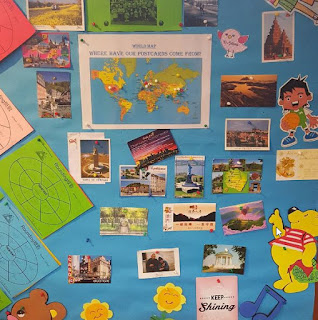
Last year I found out about an excellent program called Postcrossing . With Postcrossing, you sign up for an account and then can initially send up to 5 postcards. The addresses that you are given are random, and you must also write a code on the back of each postcard. Once the postcards arrive, they are registered by the person who receives them. After that your address goes into the random pool and you can receive a postcard from anyone doing the program, anywhere in the world. Students really enjoyed doing this last year, and it enabled us to learn a lot about the world around us, by finding connections with different places around the world. It made us all more global minded! Below is our Postcrossing board mid-year.

How to Implement Change in Schools - Portfolio Culmination of Reading Specialist Course

Image
Often implementing change in schools can be difficult, but sometimes we need to be the leaders, find other like-minded people and help in making that change happen. We need to realize that change does not and should not happen overnight, and look towards long term sustainability. This is fueled by sharing the load, changes occurring laterally (from the top to the bottom to the top), creating new leaders within work situations, having time to collaborate, valuing all opinions and then following through with actually collaborating. Teachers having time to collaborate, having an atmosphere/work situation of respect and not overloading teachers is all essential in keeping up the energy and drive necessary to affect change. Changes should be based on innovation, research, patterns and changing trends. In other words deep knowledge in an ever changing world needs to be valued. It is only through these aspects and methods that we can hope to close the achievement gap. Of course teachi...

Don't Need Friends Unit - Early Primary (Grade 1-2)

In my first practicum, I created a book based on  Don't Need Friends by Carolyn Crimi. Since it was the first I'd ever created, I feel I learned a lot from it. Creating a unit involves flexibility, time management, organization and an ability to interpret what your students need to be successful. While going through the unit, I found that I frequently had to adjust to students and different situations arising. Since one of my peers was doing a unit based on the same book, we shared a lot of ideas. Our approach sometimes overlapped, however we designed our lessons with our teaching styles, and students in mind. In remaining responsive to students, I was best able meet their needs and teach to those.

English Lesson - Friendship is... Wreath

Image
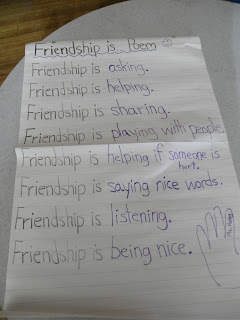
"Friendship is" was the first of two lessons discussing the meaning of friendship. It is a lesson that was designed for the the unit Don't Need Friends, as it fits into the book's overall theme. During the lesson, children had the opportunity to think about what friendship meant to them, after a friendship themed read aloud. It was apparent during the think-pair-share that students were not thinking exactly along the same vein as me, and that it was okay. Despite the fact that some of their answers did not appear to answer the question I had posed, they had obviously understood the themes and were interpreting the book in their own way. This lesson shows Commitment to Students and Student Learning since it students were eager to learn. It also reinforced the meaning of certain peer relationships, and connected student experiences to their day to day life.

Math / Literacy Lesson - If the World Were a Village

Image
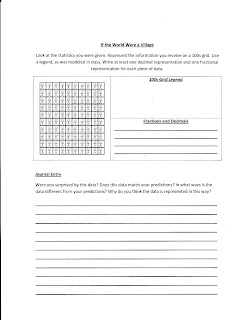
At my second practicum, I taught several lessons on fractions and decimals, including the connection between them. At the same time, I was reviewing world geography with the students, for the Social Studies Ancient Civilizations unit. As a result, I created a Math/Literacy Lesson based on the book If the World Were a Village by David Smith. The book asks the readers to suppose that the entire world is contained in a village of 100 people. The resulting lesson had students explore language, math, geography and social justice. Several of the read aloud questions were taken from a lesson plan on the website  The Society for Safe & Caring Schools & Communities . The lesson itself contains several steps/materials. It is designed to be implemented over long morning or afternoon block. When I completed this lesson, I found that the consolidation needed to be completed the following day. In order for students to be mindful and productive participators in the conversation, I gave ...