Posts

Showing posts with the label primary

Don't Need Friends Unit - Early Primary (Grade 1-2)

In my first practicum, I created a book based on  Don't Need Friends by Carolyn Crimi. Since it was the first I'd ever created, I feel I learned a lot from it. Creating a unit involves flexibility, time management, organization and an ability to interpret what your students need to be successful. While going through the unit, I found that I frequently had to adjust to students and different situations arising. Since one of my peers was doing a unit based on the same book, we shared a lot of ideas. Our approach sometimes overlapped, however we designed our lessons with our teaching styles, and students in mind. In remaining responsive to students, I was best able meet their needs and teach to those.
English Lesson - Friendship is... Wreath

Image
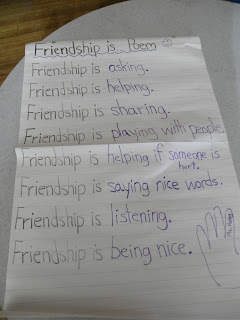
"Friendship is" was the first of two lessons discussing the meaning of friendship. It is a lesson that was designed for the the unit Don't Need Friends, as it fits into the book's overall theme. During the lesson, children had the opportunity to think about what friendship meant to them, after a friendship themed read aloud. It was apparent during the think-pair-share that students were not thinking exactly along the same vein as me, and that it was okay. Despite the fact that some of their answers did not appear to answer the question I had posed, they had obviously understood the themes and were interpreting the book in their own way. This lesson shows Commitment to Students and Student Learning since it students were eager to learn. It also reinforced the meaning of certain peer relationships, and connected student experiences to their day to day life.

Drama Rubric and Final Evaluation Form

After completing my practicum in November, I was given the opportunity to complete my first portfolio entry in class. This entry reflects my learnings from my grade one practicum. "The included artifact is one of the assessment methods that was used for the integrated unit based on the book Don't Need Friends. Students engaged in several role play activities, with an ongoing formative assessment. They did one dress rehearsal and then were given feedback, before a final performance. Final marks were based on this rubric and accompanying evaluation/comments sheet. This artifact constitutes Professional Knowledge , as it was developed after reading Growing Success with several models for assessment in mind. With regards to Professional Practice , this was the final assessment piece for the drama unit. It was developed with the curriculum in mind. Students were also told the success criteria for the performances, and "good audience member/good performer" anchor charts...

Literacy - Questioning Strategies - Grade 1

Image
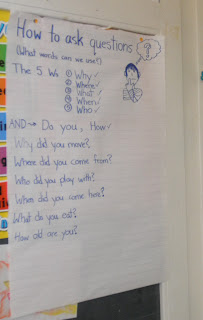
From a young age, children must learn how to ask questions, in order to be inquisitive learners. As a part of the unit for Don't Need Friends by Carolyn Crimi, I taught a posing questions class to my grade one students. By using the strategy of "teacher in role" (and being enthusiastic while acting in the role), students responded curiously, wanting to ask many different questions. For students who struggled with arriving at a question on their own, they could use the questions on the brainstorm to guide them. Students asked several questions that were not originally on the brainstormed questions list, curious about the character 'Dog'. Several children wanted to tell 'Dog' what happens in the story, and had to be reminded that they were interacting with Dog before he became friends with Rat. Students respond to the power of enthusiasm, and ideally want to have fun and learn. As a result, this artifact adheres to the objective of Commitment to Students a...

Kindergarten Inquiry Project

First semester, I completed a kindergarten inquiry project. I was curious about the way that children communicated while playing with the Big Blocks, as at that centre they were both building structures and role playing. My choice of this particular topic, in large part reflects on my belief that play is necessary for young children to learn. This inquiry project/observation correlates to the OCT's Standard of Professional Practice as it involved research, communication and observation, and will  inform my future teaching practices. Focus statement : The way children play with Big Blocks is considerably different from the way they play with smaller sized blocks. The Big Blocks are located near the role playing centres, and are used in the creation of settings/props. Students use these centres to facilitate role play. While watching the children play, I noticed how the children were compromising and creating role play settings collaboratively. Question : The kinde...

Environmentalism & Garbage - A Work of Art!

Image
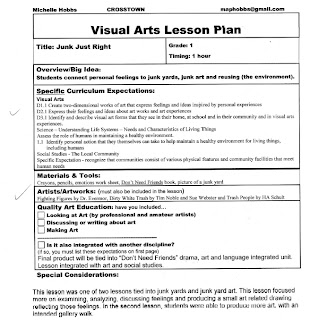
At my Grade 1 practicum, I taught several lessons that were a part of a drama, art and language unit for the book Don't Need Friends by Carolyn Crimi. This book took place in a junk yard, so at the beginning of the unit I asked students to start collecting their garbage wrappers. As the culminating task was to perform a puppet show, three art lessons took place over the course of my practicum. Students made paper bag puppets, while exploring different textures. Next they drew their reactions to garbage and art made out of garbage. Those reactions were then pasted onto a three sided piece of cardboard, which they then got to make into their personal garbage dumps. The garbage dumps were used as their stages (or what they hid behind) for their puppet show. The lesson I am going to discuss, is the one that surprised me the most. During the art lesson where students drew their reaction to garbage dumps and garbage art, students surprised me with their knowledge about the environment,...